



To celebrate the historic victory of the student–youth movement that compelled the resignation of Union Education Minister Dharmendra Pradhan, the All India Students’ Association (AISA) organised a Victory March from the Delhi University Arts Faculty to Vijaynagar today.
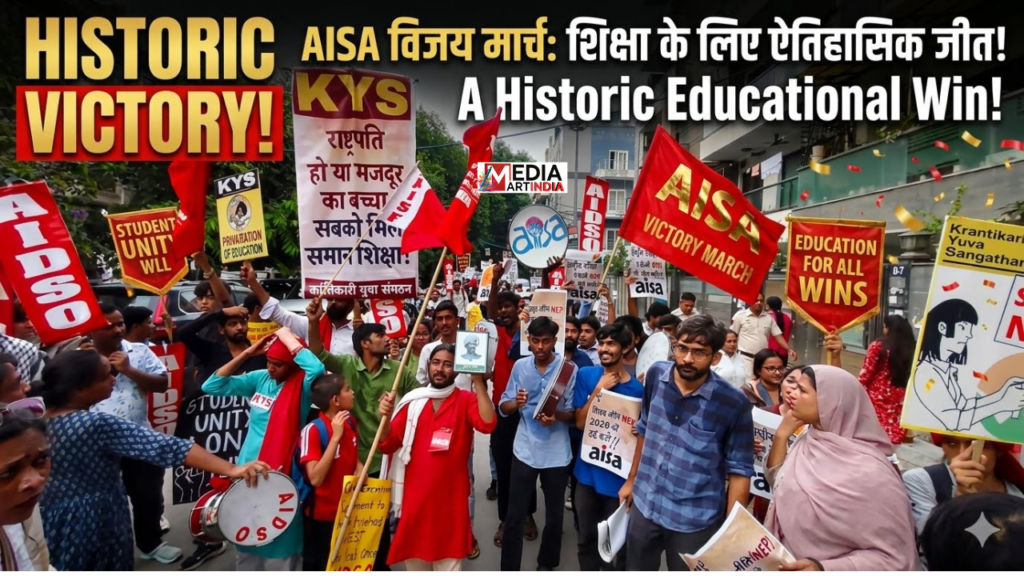
To celebrate the historic victory of the student–youth movement that compelled the resignation of Union Education Minister Dharmendra Pradhan, the All India Students’ Association (AISA) organised a Victory March from the Delhi University Arts Faculty to Vijaynagar today. Hundreds of students, youth, and democratic citizens participated in the march, carrying banners and raising slogans celebrating the power of organised student’s struggles while reiterating that the fight for a democratic education system is far from over.

The resignation of Dharmendra Pradhan is not merely the fall of an individual minister but it is one of the biggest political setbacks suffered by the Modi government in recent years. It stands as a powerful reminder that when students and youth unite with determination, even the most authoritarian governments can be forced to retreat. This victory belongs to lakhs of students, youth, teachers, workers, and democratic citizens who transformed campuses and streets across the country into centres of resistance against the commercialisation of education, the National Education Policy (NEP), the National Testing Agency (NTA), mass unemployment, and the systematic assault on democratic rights.
The movement reached a historic height through the indefinite hunger strike at Jantar Mantar, which inspired students across the country and became the moral centre of the nationwide struggle. Despite relentless intimidation, arrests, police brutality, media vilification, and repeated attempts by the government to crush the movement, students refused to back down. Addressing the gathering, Deepak, one of the AISA hunger strikers at Jantar Mantar, said: “The resignation of Dharmendra Pradhan is a victory won through the sacrifices of thousands of students across the country. But our struggle does not end with the resignation of one minister. We will continue until India has an education system based on equality, accessibility, scientific temper, and social justice. We will not stop until the National Education Policy is withdrawn, the National Testing Agency is scrapped, and every student is guaranteed the right to quality public education.”
The gathering also expressed solidarity with all those who faced state repression during the movement. Protesters recalled the brutal police crackdown on peaceful demonstrators in Delhi, where students were subjected to indiscriminate lathi-charges, tear gas, water cannons, and pellet guns merely for demanding justice. Speaking at the march, Tanvi, AISA DU Joint Secretary, who sustained serious injuries during the brutal police lathi-charge on peaceful protesters, reaffirmed the determination of the movement and extended solidarity to comrades facing repression in Bihar. She said: “State violence could not defeat this movement, and it never will. Today, as we celebrate this historic victory, we also send our deepest solidarity to all our comrades who have been arrested in Bihar for leading democratic protests. Their courage strengthens this movement. We stand firmly with them and with the people of Bihar as they prepare for the Bihar Bandh. The struggle for justice belongs to all of us.”
Participants strongly condemned the arrests of AISA leaders and activists in Bihar following the massive student mobilisation and demanded their immediate and unconditional release. The march reaffirmed that criminalising democratic protest will never silence the voices of students demanding accessible, equitable, and public education. Throughout the march, students raised slogans against the privatisation and commercialisation of education and pledged to continue building a nationwide movement capable of defending the constitutional promise of education as a public good rather than a commodity.
AISA reiterated that while today’s victory deserves celebration, the structural crisis confronting Indian education remains unresolved. The resignation of Dharmendra Pradhan represents only the first step. The movement demands the immediate withdrawal of all fabricated cases against protesting students, the release of every detained activist, and an independent judicial inquiry into the police atrocities committed against peaceful demonstrators, including the use of pellet guns.
The Victory March concluded with a collective pledge that students across the country would continue organising until every student has access to free, quality, and inclusive education without discrimination or exclusion. The historic victory achieved through this movement has opened a new chapter in the history of student struggles in India. It has demonstrated that organised resistance can defeat authoritarianism and inspire hope among millions. This victory belongs to the people. The struggle continues.