



The presentation of the Union Budget 2026-27 triggered sharp reactions across the country’s economic and political circles.
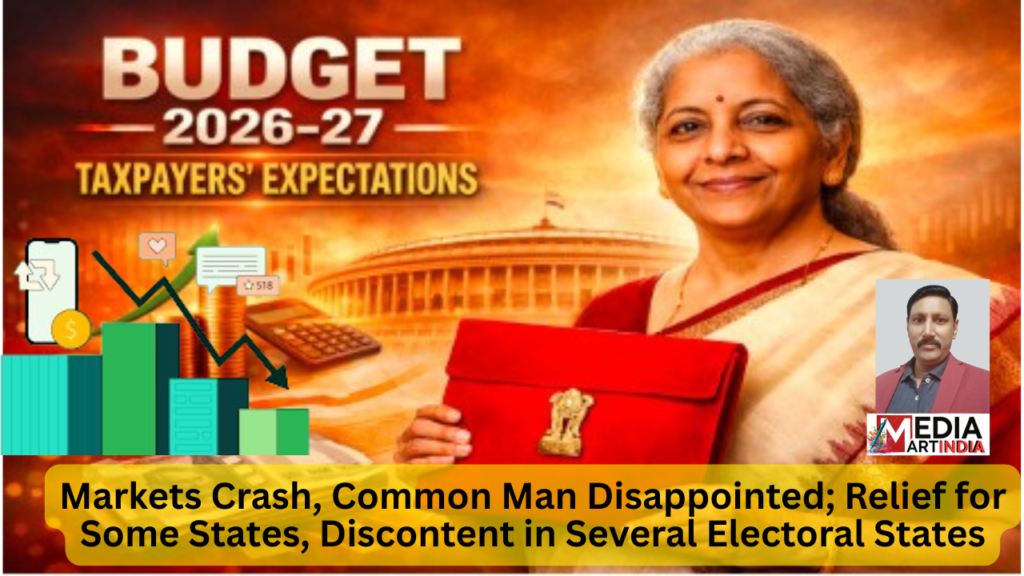
Ritesh Sinha | New Delhi:The presentation of the Union Budget 2026-27 triggered sharp reactions across the country’s economic and political circles. With a massive plunge in the stock market, it became evident that investors were dissatisfied. The Sensex and Nifty dropped nearly 1,500 points, and the rupee crossed the 85 mark, signaling that the budget lacked any solid measures to restore market confidence. The common man, too, felt deep disappointment over the absence of relief on core issues like inflation, employment, and fuel prices.This budget arrived amid global recession fears, geopolitical tensions, and domestic inflation pressures. People had hoped the government would directly address everyday needs. While the government calls it a “development-oriented” budget, critics argue it seems more anchored in numbers than on-the-ground realities.
The budget’s main focus was infrastructure. A whopping ₹10 lakh crore allocation for infra investments promises to accelerate national highways, expressways, airport expansions, and smart city projects. Railways received ₹2.5 lakh crore, including plans to increase Vande Bharat trains and redevelop 500 stations. The health sector emphasized expanding Ayushman Bharat and establishing new medical colleges. A special ₹1 lakh crore fund for the MSME sector was a key highlight.
However, these announcements are touted as future benefits, while the common man’s current struggles remain unchanged. Farmers got no legal guarantee on MSP, there was no cut in excise duty on fuel, and no major steps emerged to combat inflation. The income tax exemption limit was raised to ₹7 lakh, but without changes to the old tax slabs, the middle class isn’t fully satisfied.The stock market’s sharp reaction post-budget undermined the government’s claims.
The industry expected announcements on corporate tax cuts or incentives to boost private investment, but none materialized. Despite expanding the PLI scheme, investors’ lack of confidence was evident.Discontent deepened in electoral states. Bihar, Chhattisgarh, Maharashtra, and Jharkhand had hoped for special economic packages but received limited allocations. Bihar got just ₹20,000 crore, mainly for Ganga cleanup and road projects. Chhattisgarh’s announcements for tribal and Naxal-affected areas fell short. Maharashtra saw some infra relief, but the budget stayed silent on farmers’ loan waivers and water crises.
Jharkhand’s tribal welfare plans alongside coal production boosts raised environmental concerns.In contrast, some states stand to gain more. Uttar Pradesh received a major share through expressways, defense corridors, medical colleges, and industrial clusters. Delhi-NCR prioritized metro expansions, logistics hubs, and airport-linked projects. Gujarat got clear signals for green energy, port development, and manufacturing hubs.Southern states like Tamil Nadu and Karnataka could benefit from allocations for electronics, semiconductors, and startup ecosystems. Karnataka gained extra support under Digital India and startup schemes, while Tamil Nadu eyes gains from industrial corridors and port-based growth.
Telangana and Andhra Pradesh were prioritized in green hydrogen, logistics, and industrial investments.Positive aspects include 5G network expansion under Digital India, a ₹50,000 crore fund for Startup India, and ₹3 lakh crore for green energy. Women’s empowerment schemes, skilling one crore youth under Skill India, and a ₹6 lakh crore defense budget reflect long-term strategy.The government projects 7% GDP growth and claims to control the fiscal deficit at 5.1%, but experts warn global conditions and weak domestic demand could challenge these targets.
Overall, Budget 2026-27 emerges as a document offering clear benefits to certain states and sectors, while the common man and several electoral states feel neglected. Infra and industrial growth may pay off in the future, but without immediate relief on inflation and jobs, its political fallout could show in election results.