




India to add 6 gigawatts of wind this year behind China and US. Suzlon pips global wind firms for third-biggest order intake
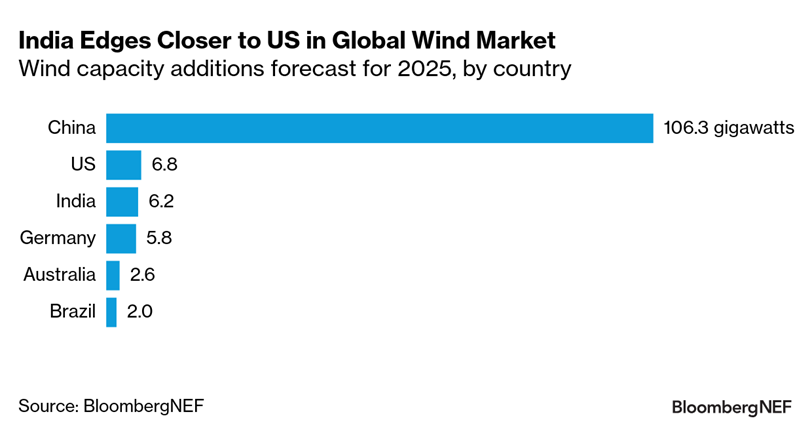
India has reclaimed third position behind China and the US in the global wind market in 2025 after record additions, according to BloombergNEF forecasts. The world’s most populous nation is forecast to add 6.2 gigawatts of wind projects this year, nearly double 2024 and placing it within striking distance of the US, the second-largest market.
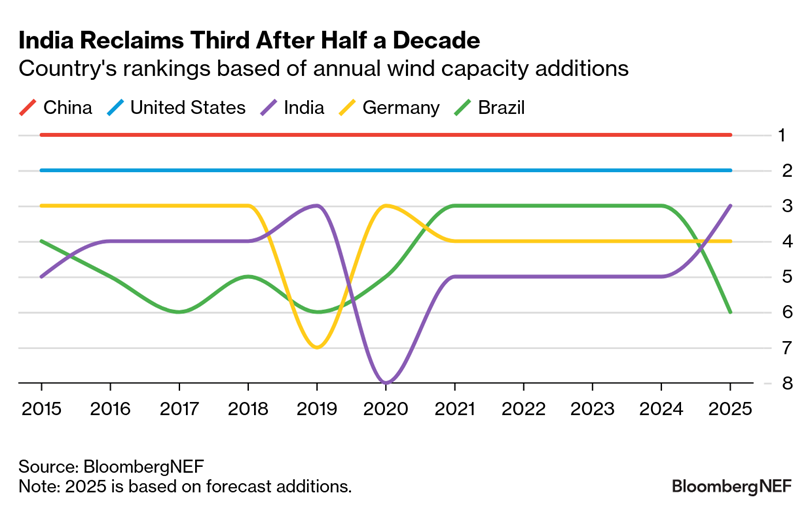
The surge in annual wind additions will help India overtake Brazil and Germany, both of which were ranked higher in the past three years. India climbs back to third for the first time in half a decade, or since 2019. The country ranked fifth consistently for four years through 2024 on account of a gradual increase in annual wind additions since 2020.
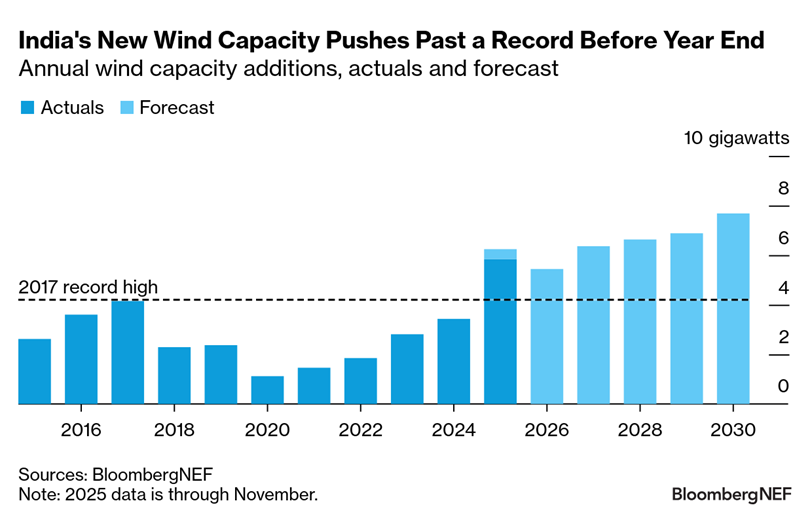
Breaks 2017 record with a month before year-end
India added 5.8 gigawatts of new wind capacity through November 2025, taking the tally past its 2017 annual record of 4.2 gigawatts. India moved abruptly to clean energy auctions from the generous feed-in tariff mechanism in 2017, which led to a sharp decline in 2018. Now, India’s wind sector is reviving on the back of complex auctions — those combining multiple power generation sources and battery energy storage technologies — and is expected to rise to nearly 8 gigawatts by 2030.
Complex auctions flip script on standalone wind tenders
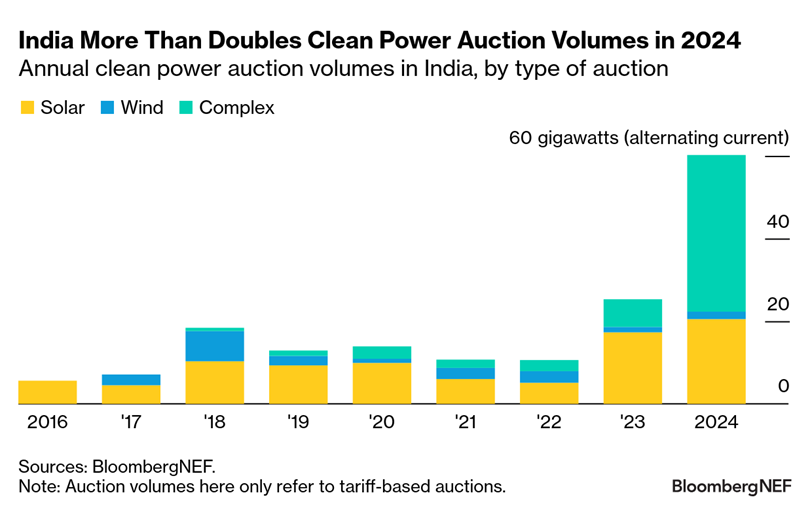
Standalone wind tenders were the main driver for wind capacity additions until 2024. Complex auctions, pioneered by India in 2018, have overtaken standalone to become the dominant driver for large-scale wind capacity buildout. Complex auctions typically require that developers integrate multiple renewable technologies. These auctions tend to focus on firmer and more reliable delivery of clean electricity, in most cases pushing developers to oversize the project beyond the contracted capacity. For example, ReNew is building 900 megawatts of wind and 400 megawatts of solar power generation capacity to meet the requirements of its 400 megawatt round-the-clock project awarded by the Solar Energy Corp. of India in 2020. Nearly 700 megawatts of wind capacity from this complex project is already commissioned, according to ReNew’s investor presentation in November. India’s auctioning agencies awarded about 60 gigawatts of clean power generation capacity in 2024, more than double the previous year. About two-thirds of the auctioned capacity was for complex projects. Given the often oversizing of projects and use of multiple power generation sources, these auctions will help India add over 30 gigawatts of wind capacity through the end of this decade.
Another reason for the surge in capacity additions this year is a spillover of projects that were expected to commission in 2024 but that were delayed by the absence of grid connectivity. Grid access has historically been a bottleneck for renewable project developers as expansion of the transmission network has a longer gestation period compared to that required to construct a solar or a wind asset. India’s federal government released a grid expansion plan in October 2024 to help connect 300 gigawatts of new power generation projects throughout the country. This plan is aimed at easing challenges faced by renewable project developers in acquiring access to the grid as well as catering to the incoming demand from future clean power build as India targets 500 gigawatts of cumulative non-fossil fuel capacity by 2030. Some of the grid expansion projects in Rajasthan, Gujarat and Karnataka were commissioned toward the end of 2024 and more were added early this year. As a result, wind projects that were installed but waiting for grid connectivity were able to commission in 2025.
Suzlon sails on India’s rise
India’s turbine order volumes rose 60% to 8 gigawatts in 2024 from the previous year. The momentum continues as orders secured by turbine makers reached 7 gigawatts through Dec. 1 this year. In the last three years, domestic turbine makers — Suzlon and Inox Wind — have commanded more than a 50% market share in annual wind turbine contracts signed in the country. Suzlon secured nearly half of all turbine orders placed in the country in the last two years. This momentum has helped Suzlon sail back to profitability after half a decade. Aside from local dominance, the Indian wind market’s rise has helped Suzlon climb the ranks among global firms competing for wind turbine orders. Suzlon ranked third globally this year for order intake outside of China through September, beating the likes of General Electric and Siemens Gamesa.
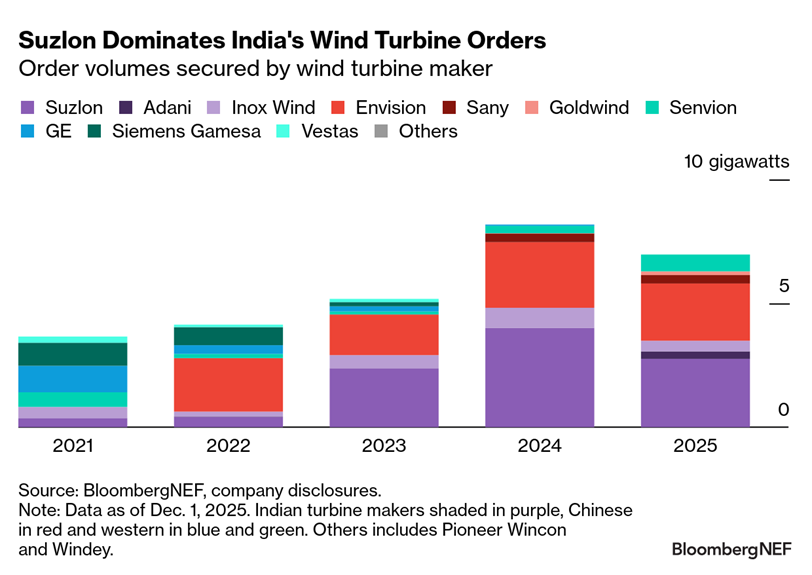
Wind projects in India must exclusively use turbine models registered on a federal list, now called the Approved List of Models and Manufacturers – Wind. To qualify for this list, the manufacturers must establish a local production unit. The soaring market has witnessed the entry of Chinese-headquartered firms Envision and Sany, which have effectively replaced the market share of western turbine makers such as General Electric and Siemens Gamesa. In 2025, the Ministry of New and Renewable Energy tightened the earlier localization mandate. Turbine makers are now required to procure upstream components such as generators, bearings, blades and more components only from a list of approved local manufacturers. This is expected to reduce the cost gap typically observed with Chinese turbine makers using upstream components imported from China. India’s surging wind capacity additions are reflected in fleet expansions of large renewable project developers. JSW Energy’s wind portfolio rose by 1.2 gigawatts in 2025, as per its corporate filings in January and November. Adani Green Energy added 0.8 gigawatts through November this year, almost double the firm’s 2024 full-year additions.