



In Sehore’s Molga village, about an hour and a half’s drive from Madhya Pradesh’s bustling capital city Bhopal, a group of villagers gather along an embankment overlooking a six-acre lake, brimming with water. Beyond it, stretch acres of lush soybean fields, nourished by water flowing steadily through sluice gates. But this was not the reality years ago, when the lake had run dry and the land lay barren.
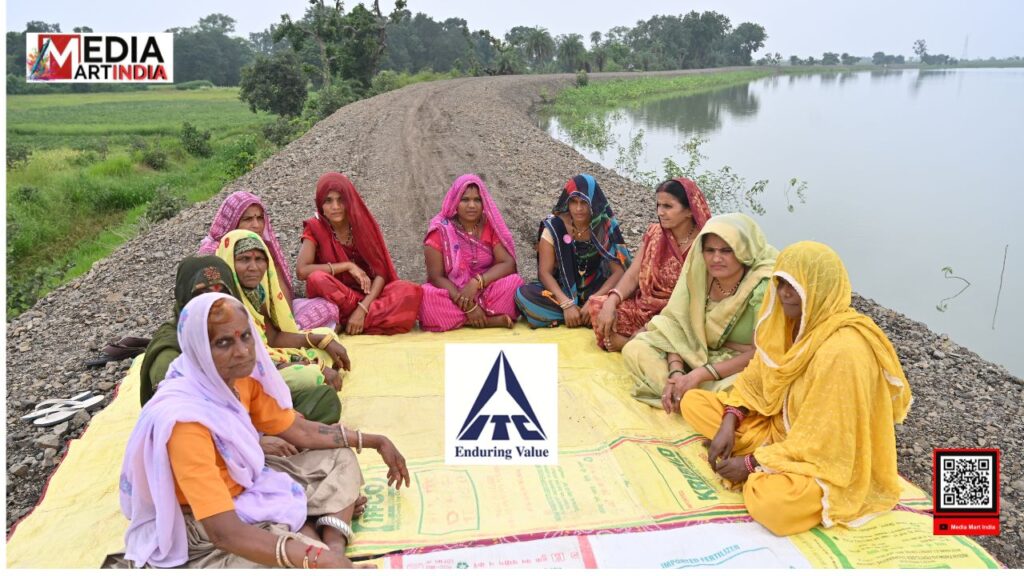
This transformation was made possible through ITC’s initiative to develop and mobilise community-led ‘Water User Groups’ (WUGs) as part of its integrated water stewardship programme. The initiative was built on a simple idea: collective action and a shift in mindset, with active participation of women. Farmers, including women, came together to revive their water resources, restore their fields, and adopt more climate-resilient farming practices.
Having involved the communities to form water user groups, ITC, along with its implementation and knowledge partners, collaborates with the community to co-create solutions, change mindsets and behaviour, promote water & climate resilient agri practices, shape governance processes, and thereby facilitate robust supply and demand side management of the water resources. Over 5,800 water user groups, initiated and nurtured by ITC across the country, form the backbone of its watershed development efforts, enabling communities to manage, sustain, and take ownership of local water resources.
ITC’s large-scale watershed development initiative has covered over 1.89 million acres benefitting over 5 lakh people across 17 states. A significant portion of this success is attributed to ITC’s strategy of decentralised governance through local community participation.
A defining feature of these water user groups is that they often leverage a strong women participation. In rural set-ups once characterised by gender inequality, women now play an active role in managing water resources with skill and confidence. They also contribute towards taking ownership for the maintenance of critical infrastructure, from desilting ponds to repairing canals and check dams, thus ensuring the long-term sustenance of the 36,900+ water structures created under ITC’s programmes till date.
As those most affected by water scarcity, women’s participation has ensured fair and equitable access of water for all, including the most marginalised households. This approach closely reflects the spirit of World Water Day 2026, theme of “Water and Gender” and guided by the message “Where Water Flows, Equality Grows”, which is a powerful reminder that empowering women is key to addressing the global water crisis.
“In inclusive Water User Groups, women play an active role in decision making on how water is managed, maintained and shared, ensuring ITC’s integrated water interventions are not only equitable and sustainable but also scalable. This approach has enabled a positive impact on the community and environment while fostering agency and a sense of empowerment among women.” said Mr. Prabhakar Lingareddy, Executive Vice President and Head – Social Investments, ITC Limited.

Under ITC’s water initiatives, women have also emerged as powerful champions of demand-side water management, with a strong focus on “More Crop Per Drop”. Also, through the Krishi Sakhi (farm-friend) programme, thousands of women have been trained as agriculture service providers, promoting micro-irrigation techniques such as drip and sprinkler systems and encouraging the adoption of a wide array of climate resilient farming practices to all farmers in the village. ITC’s water use efficiency initiatives covering 1.89 million acres, has enabled potential crop water savings of nearly 1,700 million KL in 2025-26 alone.
Nearly 2 lakh women farmers are part of ITC’s agri ecosystem, and their contribution is also visible in the more efficient use of agricultural water. These women-led efforts have helped communities appreciate the value of water and therefore, take accountability in managing the same.
The Company’s larger integrated Water Stewardship programme also includes river basin level interventions in 5 major river sub-basins.
The impact goes beyond just the environment. While the integrated efforts have helped ITC sustain its water-positive status for over 23 years, they have also brought meaningful social change for women. Improved water availability closer to homes has reduced the burden of long-distance water collection, a task traditionally carried out by women. The time saved is now being channelled into income-generating activities, including micro-enterprises and self-help groups supported by ITC.
“We used to face a lot of difficulty in getting water earlier. There was no water in the nearby borewell and I myself had to carry two pots on my head for long distances to bring water. My hands and feet would ache from the long walks in the sun and we were left with little time at home. After getting involved with ITC’s water user group, along with 10 other women, we have been contributing actively in maintaining the village dam. There has been a lot of positive change since then.” said Vimla Malvi, a woman member of a water user group in Sehore.
Women are often the primary users of water and are also most impacted by its scarcity. As is evident from the ITC model, sustainable water management is most effective when women are involved at the core of the solution, echoing the spirit of World Water Day 2026 and its focus on the vital link between water and gender.