




Indian manufacturers could face USD 55,000 to USD 110,000 in compliance and certification costs as global carbon regulations tighten/Smaller Indian exporters could also face a 15% to 20 price premium when sourcing materials from larger producers, adding to the pressure of meeting European Union (EU) Carbon Border Adjustment Mechanism (CBAM) requirements/NABKISAN Finance Limited raised INR 180 crore through India’s first social bond focused on water, sanitation, and hygiene (WASH), with the issue subscribed 1.8 times
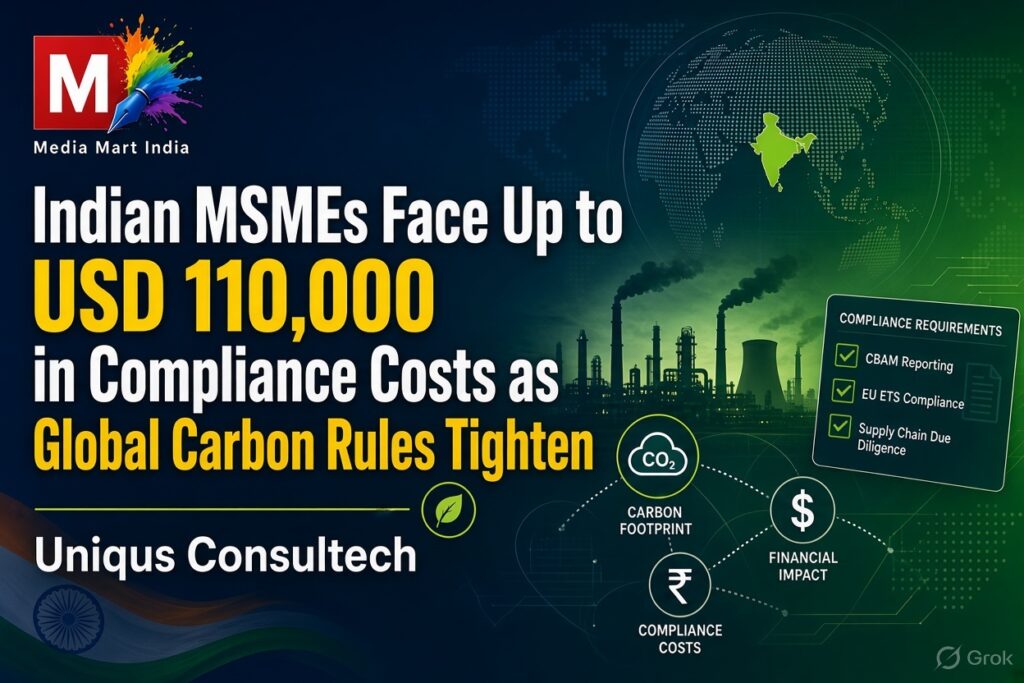
Indian businesses, particularly micro, small and medium enterprises (MSMEs) exporting to Europe, are facing rising sustainability compliance costs as carbon regulations and disclosure requirements become more stringent, according to the latest edition of Uniqus Consultech’s monthly newsletter, Sustainability & Climate Pulse. Industry estimates cited in the report indicate that compliance and certification costs could range from USD 55,000 to USD 110,000, depending on manufacturing capacity. Smaller Indian exporters are also reporting declining inquiries from European buyers, while sourcing materials from larger producers can come at a 15% to 20% price premium over secondary producers. The pressure comes as the European Union’s Carbon Border Adjustment Mechanism (CBAM) entered its definitive phase on 1 January 2026. The mechanism covers carbon-intensive imports including iron and steel, aluminum, cement, fertilizers, electricity and hydrogen. Indian manufacturers, particularly MSMEs, face challenges ranging from the cost of compliance to obtaining verified supplier emissions data and accessing certification expertise.

While EU importers are legally responsible for purchasing and surrendering CBAM certificates, Indian exporters could face indirect financial consequences through price negotiations, reduced orders or loss of market access. The report highlights the need for exporters to strengthen greenhouse-gas accounting, supply-chain traceability and emissions-data systems to remain competitive in increasingly carbon-regulated global markets. Anu Chaudhary, Partner, Global Head of Sustainability & Climate Consulting, Uniqus Consultech, said, “For Indian businesses, sustainability compliance is increasingly becoming linked to competitiveness and market access. Regulations such as CBAM mean exporters will need greater visibility into emissions across their operations and supply chains, while stronger assurance standards at home will raise expectations around the quality and credibility of sustainability information. Businesses that invest early in reliable data, traceability and strong internal controls will be better positioned to navigate this transition.”

The changing global regulatory landscape coincides with India strengthening its own sustainability assurance ecosystem. The Institute of Chartered Accountants of India (ICAI) has issued Standard on Sustainability Assurance (SSA) 5000, aligned with the international ISSA 5000 framework with modifications for the Indian context. The standard will apply to financial years beginning on or after 1 April 2027 and is intended to establish a consistent, principles-based framework for assuring sustainability information across different reporting frameworks. It is expected to strengthen the credibility and comparability of sustainability disclosures while clarifying expectations for both reporting organizations and assurance providers.

India’s domestic carbon market is also evolving. The Ministry of Environment, Forest and Climate Change issued amendments in September 2026 updating entities covered by India’s Carbon Credit Trading Scheme (CCTS). Covered entities are required to meet emissions-intensity targets, with companies outperforming those targets earning tradable carbon credit certificates and those falling short required to purchase certificates.