



In a major political development that has intensified the ongoing nationwide discourse around student rights, competitive examination irregularities, and state accountability, Samajwadi Party (SP) National President and former Uttar Pradesh Chief Minister Akhilesh Yadav, along with Member of Parliament Dimple Yadav, formally met with leading student activists at the frontline of the recent hunger strikes in New Delhi.
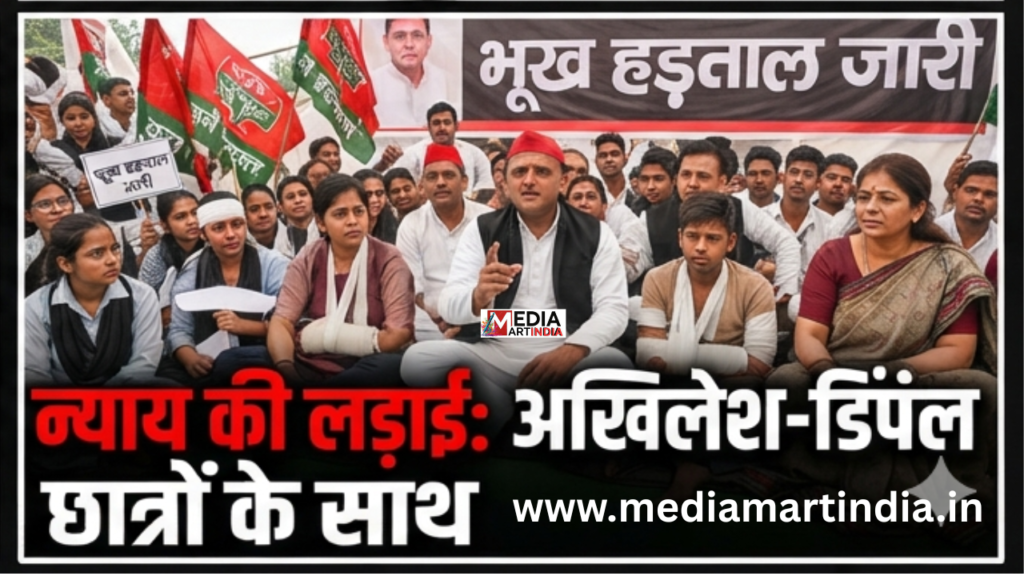
The high-profile delegation explicitly expressed deep solidarity with student representatives from the All India Students’ Association (AISA) and the Jawaharlal Nehru University Students’ Union (JNUSU). These student bodies have been leading highly charged demonstrations in the national capital against the systemic fallout of the NEET-UG examination paper leaks and related institutional structural crises.

The meeting served as an important platform for opposition forces to structurally align themselves with youth movements. Key student representatives present at the interactions included Neha (National President of AISA), Danish (Joint Secretary of JNUSU), Manish (UP State President of AISA), and Anjali (Delhi University Secretary for AISA). The SP leadership comprehensively condemned what they described as heavy-handed police brutality orchestrated by the Delhi Police against peacefully marching youth. They forcefully assured the student leaders that their ongoing movement would find robust, unyielding representation on the floor of the Indian Parliament.
Accompanying the top leadership was a dedicated cohort of younger, vocal Samajwadi Party Members of Parliament, including Rajeev Rai, Iqra Hasan, Priya Saroj, and Pushpendra Saroj, all of whom spent extensive time interacting with the hunger strikers and injured students to document their grievances firsthand. The meeting between the Samajwadi Party leadership and the student leadership did not occur in a vacuum; it marks the culmination of weeks of escalating friction over the NEET-UG competitive examination irregularities. Student outfits like AISA and various central university student unions have maintained an active, high-visibility presence at Delhi’s historic Jantar Mantar protest site. Their core demands focus on structural overhaul
The complete scrapping of compromised test frameworks. The resignation of Union Education Minister Dharmendra Pradhan. A thoroughly independent, court-monitored investigation into national testing mechanisms. To force the government’s hand, student representatives resorted to an indefinite hunger strike, a grueling democratic protest format that has significantly compromised the physical health of several young leaders. The situation dramatically escalated during a planned peaceful march from Jantar Mantar toward the Parliament building. Security forces deployed structural barricading, tear gas shells, and eventual lathi-charges to break up the gathering, resulting in several student activists sustaining severe physical injuries. Reports highlighting the physical injuries sustained by female student activists particularly triggered widespread public outrage, creating an environment that prompted mainstream political leaders to step out of legislative chambers and directly onto the streets.
When Akhilesh Yadav and Dimple Yadav arrived to meet the hunger strikers, it signaled a calculated transition from legislative debate to direct, grassroots involvement. Akhilesh Yadav, a seasoned political figure who has built his party’s current platform on the foundational baseline of PDA (Pichhada, Dalit, Alpasankhyak—Backward, Dalit, and Minority communities), framed the student crisis as a direct assault on the collective aspirations of India’s working-class and rural families.
| Key Political Figure | Role / Constituency | Primary Action / Statement during Visit |
|---|---|---|
| Shri Akhilesh Yadav | National President, SP / Former UP CM | Condemned Delhi Police actions; pledged structural parliamentary resistance against anti-student policies. |
| Dimple Yadav | Member of Parliament, Mainpuri | Directly interacted with injured student activists; breached barricades to offer immediate on-ground solidarity. |
| Iqra Hasan | Member of Parliament, Kairana | Engaged with university representatives to map localized educational grievances into national policy demands. |
| Rajeev Rai | Member of Parliament, Ghosi | Reviewed documentation regarding student detentions and physical treatment by police forces. |
| Priya Saroj | Member of Parliament, Machhlishahr | Highlighted the specific vulnerability of young female scholars facing state-backed crackdowns. |
| Pushpendra Saroj | Member of Parliament, Kaushambi | Offered youth-led administrative support to coordinate medical assistance for fasting students. |
Dimple Yadav’s presence at the protest site introduced a highly visible element of active resistance. Known for her deliberate, measured public presentation, her actions at Jantar Mantar—which included confronting security barriers to comfort weeping and physically bandaged female student leaders—captured significant media attention. Her public statements targeted what she termed the “callous rigidity” of the central government, emphasizing that a state which responds to peaceful academic grievances with physical force and internet shutdowns loses its moral authority to govern.
The core of the interaction focused on a detailed brief presented by the student leadership to the visiting parliamentarians. Neha, the National President of AISA, outlined the structural toll that the continuous examination leaks have taken on millions of middle-class and marginalized students across India. She emphasized that the hunger strike was a measure of absolute last resort, taken because official institutional channels had consistently refused to offer a transparent dialogue. Danish, the JNUSU Joint Secretary, explicitly detailed the mechanics of the police crackdown on the Sansad Chalo (March to Parliament) initiative. He provided accounts of how students were corralled, physically assaulted with batons, and arbitrarily detained in distant police stations without access to immediate medical care or legal counsel.
Representing the regional perspective, Manish, the UP State President of AISA, explained to Akhilesh Yadav how testing irregularities are structurally devastating youth morale across Uttar Pradesh. He noted that the state’s youth are caught in a cycle of preparing for highly competitive exams only to watch paper leaks nullify months of labor and financial investment. Anjali, the AISA DU Secretary, emphasized that the crackdown within Delhi University spaces had reached a level where peaceful student assemblies were treated as potential law-and-order threats rather than legitimate democratic expressions. A critical outcome of this solidarity meeting is the explicit pledge by the Samajwadi Party leadership to seamlessly transfer the momentum of the street protests into the chambers of Parliament. Akhilesh Yadav assured the student leadership that the party would not treat their meeting as a mere photo opportunity. Instead, the SP legislative bloc—which has emerged as a formidable opposition force in the Lok Sabha—intends to use strategic parliamentary mechanisms to hold the Ministry of Education accountable. The younger cohort of MPs present—Iqra Hasan, Priya Saroj, Pushpendra Saroj, and Rajeev Rai—signify the generational shift the Samajwadi Party is trying to achieve. Being among the youngest lawmakers in the current legislative session, these MPs are uniquely positioned to articulate the anxieties of a student demographic that feels entirely disenfranchised by the current institutional framework. They committed to This high-visibility intervention by the top echelon of the Samajwadi Party underscores a changing political calculus in India. By physically showing up at Jantar Mantar and aligning with left-wing student organizations like AISA and JNUSU, the SP is positioning itself as a broad-based, multi-demographic champion of youth welfare. This strategy deliberately expands their traditional regional focus into national-level systemic advocacy.
The image of Dimple Yadav scaling police barricades and comforting injured youth serves as a powerful visual counter-narrative to the government’s official position. It provides the opposition with a potent symbol of active, empathetic on-the-ground resistance. As the current parliamentary session progresses, this unified front between student movements and powerful regional parties promises to keep the central government under sustained political pressure. The student movement is no longer isolated to campus quadrangles; it now has a direct, amplified channel into the highest legislative halls of the country.