



The resignation of Union Education Minister Dharmendra Pradhan is a historic victory achieved through the indomitable struggle of lakhs of students, youth, and democratic citizens across the country.
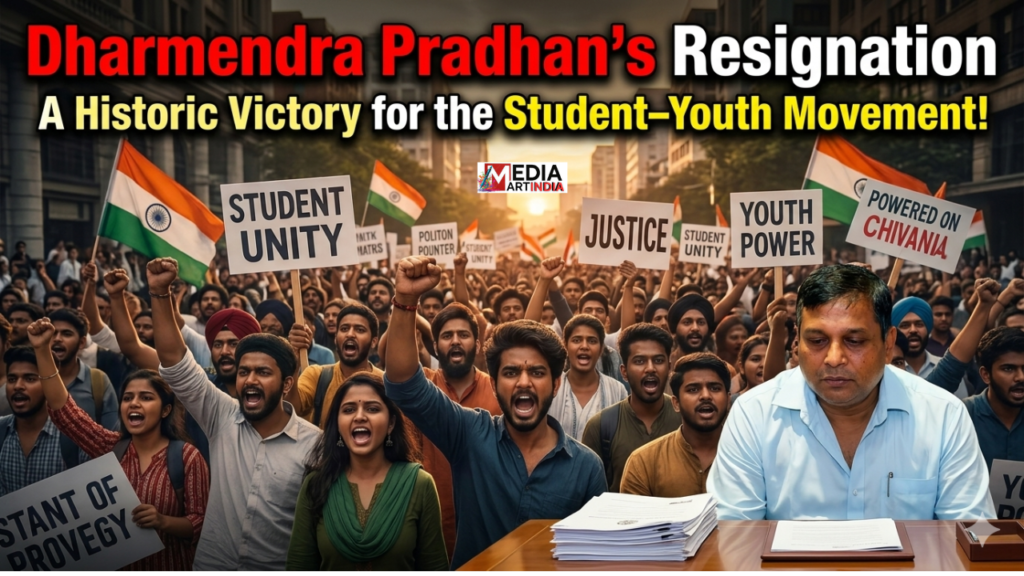
This marks one of the Modi government’s biggest political setbacks in the last fourteen years and reaffirms a simple truth: organised people’s struggles can compel even the most authoritarian regimes to retreat.
A Nationwide People’s Movement- What began as a protest against the deepening crisis in education grew into one of the largest student mobilisations in recent years. Campuses and streets across the country became centres of resistance as students and youth rose against the commercialisation of education, mass unemployment, the National Education Policy (NEP), the National Testing Agency (NTA), and the erosion of democratic rights. At the heart of this movement stood the indefinite hunger strike. We salute Sonam Wangchuk, Comrade Neha, Comrade Danish, Comrade Manish, Comrade Aameen, Comrade Deepak, and Comrade Hrishikesh, whose courage inspired millions. We also salute students, youth, and activists from democratic and people’s organisations who joined the hunger strike in solidarity, strengthening this historic struggle.

State Repression Failed to Break the Movement. The Modi government responded to the ‘Sansad Chalo’ march with brute force. On the 19th day of his hunger strike, Sonam Wangchuk was forcibly picked up and illegally detained from the protest site. On 20 July, protesters were met with lathi-charges, tear gas, water cannons, and pellet guns. A 21-year-old young woman was so grievously injured that she had to be placed on a ventilator. Another young protester, Sahil Lochab, almost lost his eyesight due to pellet injuries. In Bihar, a massive protest took place on 22 July. Thousands of students participated in the demonstration convened by AISA. An unprecedented crackdown was unleashed on the protesters. Many were injured due to indiscriminate lathi-charges and water cannons. Yet the spirited participation of ordinary students transformed the protest site in Patna into a carnival of resistance.
The Movement Spread Across the Country.On 24 July, tens of thousands of citizens poured onto the streets of Kolkata demanding Dharmendra Pradhan’s resignation. Several AISA leaders were arrested, and protesters continue to face the threat of severe repression. Mumbai also witnessed some of the largest and most spirited protests in recent times at Azad Maidan, Shivaji Park, Chaitya Bhumi, Chembur, Vashi, and Powai. Public figures including Prakash Ambedkar participated in these demonstrations. Film personalities such as Ayesha Khan, Imran Khan, Huma Qureshi, Emiway Bantai, Raftaar, and Anuv Jain also joined the protests.
Several prominent artistes—including Alia Bhatt, Sonakshi Sinha, Kareena Kapoor Khan, Ishaan Khatter, Rajkummar Rao, and Rasika Dugal—expressed their solidarity on social media. Veteran actors and public figures including Naseeruddin Shah, Ratna Pathak Shah, Shabana Azmi, Raghubir Yadav, Dia Mirza, Hrithik Roshan, and T. J. Bhanu also voiced their support. Shabana Azmi, Arundhati Roy, Nivedita Menon, Yogendra Yadav, Sagarika Ghose, Manoj Jha, Anita Rampal, and several other public intellectuals expressed solidarity with the hunger strikers in Delhi.
Violence Only Strengthened the Struggle. Across the country, the police and administration responded to peaceful protests in the same manner—with wanton violence and repression. These attacks only exposed the government’s fear of an organised student movement and strengthened our resolve. We stand with every injured protester and demand justice and accountability for this assault on democratic rights. The government also sought to vilify the movement. BJP leaders branded it “anti-national”, while the godi media attempted to delegitimise a mass democratic struggle. The detention and assault on Rahul Gandhi and other Congress leaders further exposed the regime’s intolerance towards democratic dissent.
A People’s Victory,Dharmendra Pradhan dismissed the movement as “anti-national” and refused to acknowledge the deep crisis confronting India’s education system. Sensing mounting public anger, the Prime Minister attempted to salvage his image through late-night social media videos. However, the protesters refused to be distracted by these eyewash tactics and instead resolved to intensify the movement. Today, the very minister who sought to discredit this movement has finally been forced to resign.
The Struggle Continues, While we celebrate this historic achievement, our struggle is far from over. All detained and arrested protesters must be released immediately, and all fabricated cases against them must be withdrawn without delay. An independent judicial inquiry must investigate the police atrocities of 20 July, including the use of pellet guns against peaceful demonstrators, and those responsible must be held accountable. Our fight is not merely for the resignation of one minister but for the democratisation of education. The National Testing Agency must be scrapped, and the National Education Policy—which deepens exclusion, privatisation, and commercialisation of education—must be withdrawn.
India needs an education system founded on equality, accessibility, social justice, and democratic participation. The NEP, however, is designed to serve the market and the authoritarian ambitions of the ruling regime. The movement has opened a new chapter in the history of democratic struggles in India. This victory belongs to the people, The struggle shall continue, Onwards for a democratic, equitable, secular, and free India, Long live the student–youth movement, AISA